
Five Finger Mountain
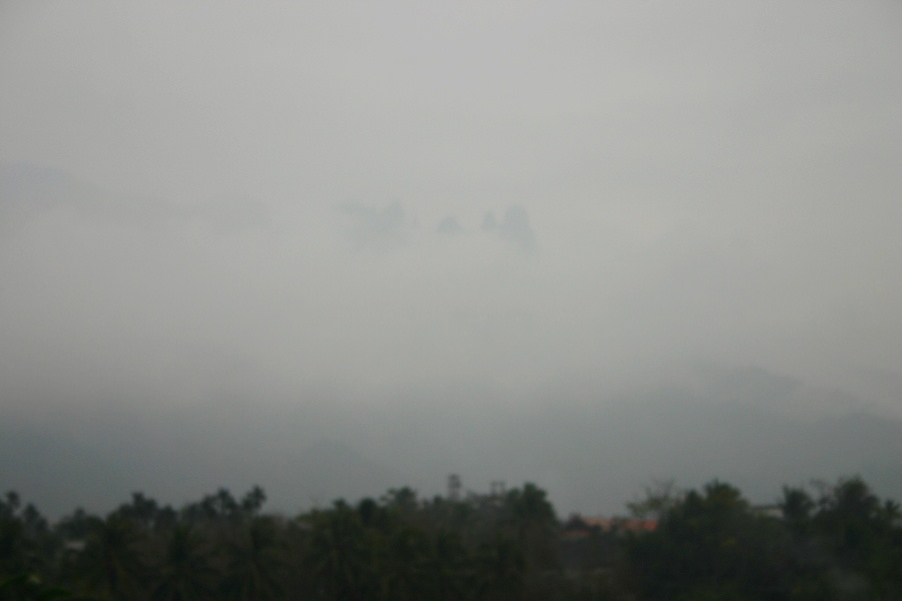
邱浚(明)
五峰如指翠相连,
撑起炎荒半壁天。
夜盥银河摘星斗,
朝探碧落弄云烟。
雨余玉笋空中现,
月出明珠掌上悬。
岂是巨灵伸一臂,
遥从海外数中原。
FIVE FINGER MOUNTAIN
Qui Jun (1421-1495)
Ming dynasty1368-1644
Five peaks resembling five fingers green, intertwined,
Jut from the hot wilderness veiling half the sky.
At night they pluck cosmic stars from the Milky Way,
At dawn they caress the hovering misty haze.
In the wake of rain, five jade-shoots loom in the air,
Rising moon hangs like a pearl over the palm there.
Isn’t it the mount’n god stretching his arm to count
Far distance across the shore central Kingdom’s mounts?
(Translated by Karl Wen Sun)
Note on translation:
Born in Qiongzhou (now Hainan), Wikipedia describes 丘濬 (Qiu Jun) as a prominent Chinese
politician, scholar, poet, and economist during the Ming Dynasty, who is recognized as a master of Confucian literature, sometimes referred to as the leader of literary officials of his time.
During the 2010s, I became acquainted with the direct descendants of the great poet—the vice- principal of a well-known elementary school in Haikou and her young son. They took me to the local History Museum, where her ancestor was honored with a statue and a display of his poems. At the time, I had just finished an English book for young readers featuring a fifth-grader named Lily, through whose life readers explore the local culture. In one chapter, Lily joins her father on a work trip to the rainforest; moved by the sight of the Five-Figure Mountain, she recites a poem that bears the same name. Through my volunteer work at her school, the vice-principal was thrilled to see her ancestor’s literary work featured in my book.
The poem "Wuzhishan" is written in the traditional Qiyan style, consisting of eight lines with
seven characters each. Translating this directly into seven-syllable English lines proved
impossible, as a single Chinese character often requires a full English phrase to capture its
meaning. While I initially considered the ten-syllable meter of English sonnets, I eventually
settled on a twelve-syllable rhythm. This structure, famously used in certain ancient poetic
traditions, worked perfectly to accommodate the translation. By using this meter, I was able to
maintain a rhyming couplet every two lines, preserving a truly poetic feel.
Qiu Jun’s political background explains why he connected Hainan’s peaks with the mountains of central China—a gesture meant to signal his allegiance to the imperial court, in my opinion.
岂是巨灵伸一臂,
遥从海外数中原。
Isn’t it the mount’n god stretching his arm to count
Far distance across the shore central Kingdom’s mounts?
I do not claim to be a trained critic of ancient Chinese poetry, nor am I a professional translator of it. In fact, I never memorized classical poems during my school years. Despite this lack of formal training, I occasionally find myself composing poems in Chinese or English when the whim strikes me. I deeply value your expert comments and look forward to your opinions.

Comments